Athlone food scene: the outlier
Up until three years ago, there was no place to get good coffee in Athlone, well, not until The Butcher’s Wife opened its doors in Belgravia Road.
When one thinks of the food and beverage scene in Athlone, moreish gatsbies, mouthwatering salomies and ‘slap’ chips comes to mind. One thinks of bustling Halaal takeaways with queues of people waiting patiently for their white-paper wrapped bundle of goodness with a sneaky side of hypertension. At night the establishments come to life with neon signs shining bright and cars parked in every nook and cranny, particularly on Belgravia and Klipfontein roads. It is here that two of the most famous and frequented places stand, Golden Dish and Wembley Roadhouse.
The Butcher’s Wife, located a stone’s throw away from the iconic Wembley Roadhouse, in many ways defies this stereotypical view of Athlone food.
The fully Halaal menu offers tempting tempura prawns, tender wagyu and even dry-aged steaks – food offerings commonly found in a menu at a City Bowl eatery but out of the ordinary in an Athlone restaurant. Even banting bases are offered here.
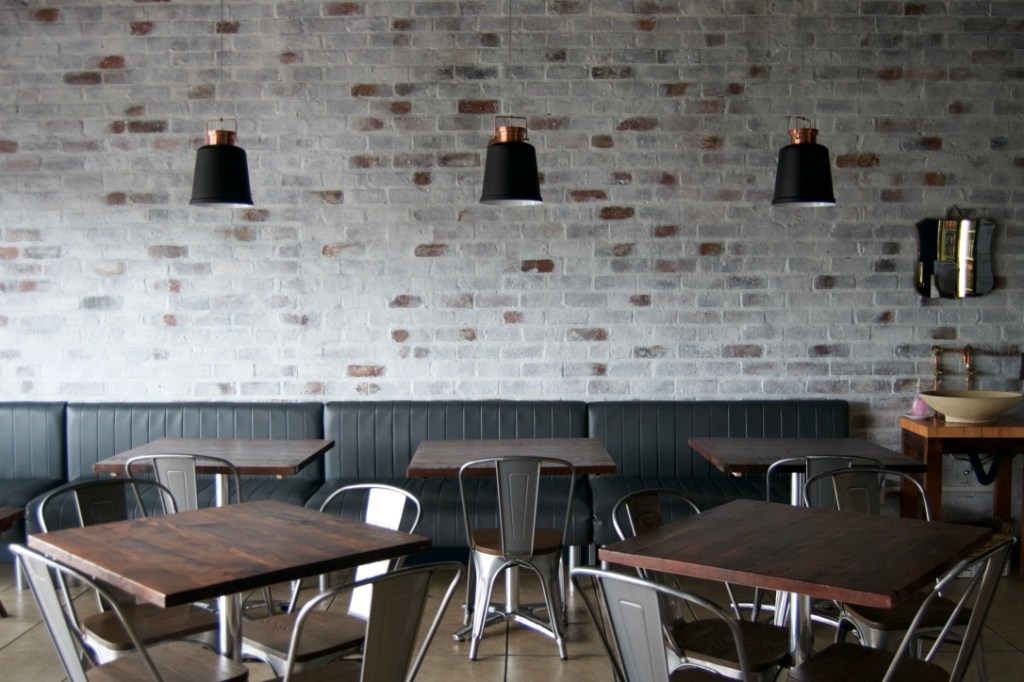
Interior at The Butcher’s Wife
Not only is the food an anomaly in the area but the sit-down format as well. The eateryis the first sit-down, stand-alone restaurant in the area. The restaurant also offers a take-away option. Other sit-down restaurants have opened at the Vangate Mall but these are mainly chain establishments which are well-known throughout the province, even across the nation.
For patrons who are used to dining and dashing the inviting, comfortable yet sophisticated interior at The Butcher’s Wife is another surprise. The interior has a retro feel featuring natural fabrics, like denim and wood in a simple design. Accessories include brass pipes, unused taps and antique mirrors to add to the nostalgic feel. And bringing the eatery bang up to date, the owner has included brass and copper light fittings which are frequently seen in trendy restaurants in the CBD.
I attended a high school in Rondebosch and I would hear my classmates talk about how they would pop down the road for a coffee date on the weekend. It was during these years that I realised that most areas in the Southern Suburbs and the City Bowl are home to several coffee shops, sometimes even multiple ones on the same street! This prompted me to question why I could not find a cute coffee spot in Athlone in and amongst the gatsby and tikka chicken joints. At the same time we were learning about apartheid during history class and the Group Areas Act caught my attention as a contributing factor to the lack of charming cafès in Athlone.
Apartheid spatial planning
This infamous Act enacted in the 1950s saw the displacement of people of colour from central parts of town to the Cape Flats and townships in far out areas. This displacement forced people to build a new camaraderie in their newly found communities. The bonds built at this time would prove to be the foundations for a well-connected neighbourhood where everyone felt like family.
Families who used to stay in the leafy suburbs and more central areas were forced out and with them went their businesses. Tasneem Wentzel in her paper, titled Producing and Consuming the Wembley Whopper and the Super Fisheries Gatsby: Bread Winners and Losers in Athlone, Cape Town, says the culinary heritage, especially the dominance of bread-based food offerings of the Cape is intricately linked to apartheid laws and regulations.
During the reign of the National Party from 1948 to 1980, white bread was subsidised and regulated by the government. The 1950s to the 1960s are frequently referred to as the “‘wittebroodsdae”[1] where the booming wheat-bread industry reflected a growing self-sufficient white South Africa. White bread forms the basis of gatsbies and several other food items on offer at eateries traditionally known as Halaal takeaways. As a result of the forced relocation, the travel journey from work to home became much longer and cumbersome which meant that people needed a quick and affordable fix for meals.
Homegrown quintessential Halaal takeaways
The need for food on the go was swiftly met by a string of Halaal takeaways which opened their doors in the 1970s. Wentzel points out that their critical timing indicates that the creation of these establishments was, in some way, a reaction to the intensified political climate and shifting labour market. Serving the people in the area was the prime objective.
In Athlone, among the first establishments on the block were Super Fisheries with their signature gatsby and Wembley Roadhouse with the archetypal whopper burger. These establishments, despite their food offerings, are generally not referred to as fast food for several reasons. For starters, categorising them as fast food joints would be false advertising because believe me, the wait will never be under twenty minutes, even for a small chip roll. Beyond the tedious wait (which is always worth it) these businesses generally operate on a smaller scale when compared to mainstream fast food establishments. Halaal takeaways are almost always family-based businesses, featuring secret recipes passed down through generations. Wentzel says these takeaways were and still are able to combine the foundations of fast food with the flavours of home-cooked food. Therein lies its authenticity.
The food offerings are unique and bridge the gap between normal fast food and sit-down restaurant. I say this because fast food burgers are usually comprised of a generic meat patty, creamy mayonnaise and some sort of vegetable or pickle, for an illusion of healthiness, all sat atop a soft but clearly mass-produced roll. Delicious, nonetheless. However, a burger from a Halaal takeaway features a chunk of steak, topped with braised onions, garden salad for good measure and a squeeze of tangy homemade sauce all sitting on a sesame-seed roll. Big difference. The menu at a Halaal takeaway is broader than that of a fast food joint as it includes curries, pastas, pizzas and even breyani. Now I must admit that I may be a bit biased towards these takeaways but it’s so good that I cannot apologise for it!
The makings of the first sit-down restaurant in Athlone
Now that you have a sensory visual and are probably salivating at the food scene in Athlone, we will take a deeper look at the exception to the norm that is The Butcher’s Wife.
The owner of the establishment, a Muslim women Qudsiya Gangraker is literally a butcher’s wife. Not only is the restaurant quirky in its very existence but its backstory is endearing too.
Grangraker is wife to an owner of Pickers Meat, a family-owned brand which was established in 1994. The Butcher’s Wife exclusively uses Pickers Meat in all of its food offerings, remaining true to the family-oriented practices in Athlone eateries. In a conversation with Gangraker, who grew up in Athlone, she said her husband’s link to the meat trade opened a new door in her food journey. Her parents were grocers so naturally food trade was in the family. In the interview a dazzling Gangraker and her brand manager, Michelle Ressel took us down memory lane.
The pair started their journey in a franchise, St Elmos. The chain, known for pizzas and pastas closed its doors towards the end of 2016. In bringing the pizza chain to Athlone, the pair worked on created food offerings which suited the community it would serve. It was amongst the first in the chain to create a fully Halaal menu, in other parts of the country there was never an apparent demand for a Halaal menu. And to satisfy the chilli-loving palates, the seasonings and aromatics were adjusted. When the pizza chain closed down, Gangraker boldly decided to combine her knowledge of the Italian-inspired pizza, pasta food offerings and her husband’s meat trading expertise to bring into being The Butcher’s Wife.
A family establishment: by the people, for the people
In devising the concept for the trailblazing establishment, Gangraker and her team had the people of Athlone as their main focus. As a mother of three, Gangraker noticed the apparent need for a Halaal, family-friendly, sit-down restaurant in the area. Families enjoy eating out a great deal and she knew that they could do with an eatery that offered more than standard offerings at the traditional takeaways. At The Butcher’s Wife, the motto is, “we sell what we eat”. Wood-fired pizza, gourmet grills, pasta, artisanal burgers and a scrumptious array of breakfast options. Now these menu items may not sound like food one would make at home but the flavours taste of home.
Whilst conversing with Gangraker at her restaurant, a family popped in for lunch. The children immediately rushed to Gangraker’s side for a big hug as the parents waved them over to their table. This interaction is a testament to the types of community in Athlone and the welcoming nature of The Butcher’s Wife. The restaurant’s brand manager, Michelle Ressel, said the advertising for the launch of the establishment was almost exclusively through word of mouth. Later the eatery created a profile on Instagram, which now boasts almost 7000 followers,but in the very beginning it was locals recommending the place that got feet in the door. Gangraker said she always knew how important the community is as the business should fulfill the needs of the population in the area. She says although the eatery was out of the ordinary for Athlone, it was met with praise and delight from the day it opened.
It is clear that the cosmopolitan nature of the café has been a breath of fresh air in the community, last month a coffee loyalty card was launched. So far, we have spoken little about the beverages which in this day and age, where many people cannot start their without a proper cup of coffee, are equally as important as the food offerings. At the usual Halaal takeaways the beverage list is usually limited to soft drinks with the exception of the exemplary Falooda made with rose syrup which remains a firm favourite. The Butcher’s Wife truly sets itself apart with its hot drink options, which include various coffee beverages – one would struggle to find these elsewhere in Athlone.
As one can see The Butcher’s Wife mimics the community-centered culture cultivated by the Halaal takeaways which form a defining role in our culinary heritage.
Succeeding on the periphery
The Group Areas Act pushed people of colour into the outskirts of the city, away from the City Bowl and with that came the othering of these displaced communities. People do not expect to find artisanal coffee shops, gourmet food offerings and sophisticated eateries on the Cape Flats. They expect the usual, dine-and-dash Halaal takeaways and nothing more.
“People come and say, we would never have known that you can have something like this in Athlone. Then I thought, why not, don’t we deserve to have something like this?”
These were Gangraker’s words, she says restaurants in the suburbs are not celebrated enough. Most foodies gush over the delectable food on offer in the CBD, the Atlantic Seaboard and Constantia but they neglect those on the periphery. Food outlets in the Cape Flats exist outside of the mainstream and are therefore seen to exist on the periphery. It is an extended manifestation of apartheid-era spatial planning which continues to exist, especially in Cape Town. A self-appointed dyt[2] specialist, Huda says halaal takeaways do not exist on the periphery to the people on the Cape Flats rather, these illustrious eateries are at the centre. Despite the fact that the majority of Capetonians indulge in these takeaways fairly frequently, the city’s minority, who wield the economic and social power, continue to diminish their successes.
Gangraker says she cannot charge her diners the same prices one would pay at a mainstream restaurant in the city. The families here, are for the most part, not aware of the high prices restaurant charge and therefore would not be prepared to pay those hefty prices at The Butcher’s Wife. For this reason, she keeps her prices relatively low, without compromising on the quality and consistency of the food. However, Gangraker says that Halaal consumers are willing to spend a reasonable portion of their disposable income and this spending capacity is frequently underestimated. Media and people in general tend to believe that the big eaters and therefore money lies in affluent suburbs and the CBD.
The Butcher’s Wife breaks the stereotype and even the toughest of critics approve
The grannies in the
family are notorious for their fussy eating habits, they will not smile and
move on if their taste buds are dissatisfied. Bold as ever, they will voice
their opinions. Gangraker says even these ladies, the toughest of critics gleefully
enjoy a feast at The Butcher’s Wife. Even
though many of them grew up eating foods from Halaal takeaways they have
clearly welcomed The Butcher’s Wife
into their dining out regime.
[1] Reference to the honeymoon phase for the white population in Apartheid South Africa
[2] Slang word used on the Cape Flats to denote eating
 Umami politics