Political discourse, especially amongst the youth, is a cornerstone to maintaining a healthy democracy. But as a non-partisan young person in South Africa, spaces that facilitate meaningful political conversation, a pseudo-public sphere, are hard to find. This vacuum is likely a key factor contributing to youth’s apparent disengagement in politics.
The youth is going through a lot in the country; with youth unemployment sitting at 70%, the price tag on education sky-rocketing and incidences of discrimination occurring way too often. And for these gloomy reasons most youth do not support the three leading parties.
Not supporting a leading party means there is no space to facilitate valuable political discourse, if you belong to a political party there are branch meetings which provide a space for such discussions. However, as a growing number of young people feel their views are not represented by the countries’ political parties finding a space for political discussion is becoming more difficult.
One of the lesser spoken about parts of the Fees Must Fall protests was the political education discourse sessions. In these sessions, partisans and non-partisans came together to be educated, challenged and, most importantly, to actively engage. These sessions often centered around the process of decolonisation, feminism, intersectionality and identity politics and were often chaired by learned professors. The discussions prompted further informal conversations about the issues facing the “born free youth”. It allowed us to deepen our understanding of the country, its complicated history as well as the future of the nation. Drawing on my own experiences in these conversations, I recall sitting in Memorial Hall with friends, new and old, listening to different speakers talk about the complexity of intersectionality.
Listening to these talks and engaging with fellow students helped me to understand the lived realities of others which in turn made me question the decisions I make on a daily basis. It changed the way I think about the political sphere of our society: going from blindly admiring the work of Mandela’s ANC to questioning the erasure and romanticisation of certain actors during that transitional time. Critical thinking.
The movement was powerful but, in many ways, short-lived, particularly the inclusive political education sessions. Now there is a vacuum. And as many students would know, education institutions do not make much effort to provide a space for political discourse, this needs to change.
The Habermasian conception of the public sphere is rooted in the idea that the sphere is able to mediate between the state and society. The arena is designated for discourse and rationalizing political domination thereby the citizenry works to hold the state accountable. As contemporary thinkers have shown, there exists a multitude of competing public spheres. A key element of democracy is freedom of expression and therefore it is important for competing arenas of political discourse to exist so that all people feel they have a space to speak about their political views while still being challenged.
In the days preceding the 9 May, election day, this year, the most common question many were asking themselves was… Who should I vote for? A question that requires more than just consuming media reports and endless manifestos to answer. The question requires robust discussion.
One might say that social media has become the new public sphere, but sadly it is not. On social media, users are allowed to share their views freely but the quality of discussion and more importantly the potential for that discussion to educate and inform opinions is highly unlikely. This is not because there are no knowledgeable people on social media sharing their views but rather the issue lies in the quality of the political discourse that the medium is able to sustain.
The existence of bots and internet ‘trolls’ is something many are all too familiar with. Bots and “trolls” are common culprits when it comes to derailing political discourses online. Fear of harassment and cyber- bullying as a result of political views is a reality, due to these culprits, which inturn may prevent users from sharing their honest political views. The lack of plurality in the opinions you may encounter feeds into creating a conversation of inferior quality. A user is able to, with some exceptions, curate their newsfeed. By following certain accounts, they are more likely to see posts by like-minded people. Finally, the issue of access. Active social media users account for a very small percentage of South Africans and often creates a false illusion of the country’s reality. Getting caught up in this bubble is a problem.
South Africa is a young democracy with a young population that is engaged yet disengaged and politically aware and yet politically disillusioned. We cannot allow these contradictions to exist, we need to work towards creating a space to faciliate non-partisan political discussion. [792 words]
Up until three years ago, there was no place to get good coffee in Athlone, well, not until The Butcher’s Wife opened its doors in Belgravia Road.
When one thinks of the food and beverage scene in Athlone, moreish gatsbies, mouthwatering salomies and ‘slap’ chips comes to mind. One thinks of bustling Halaal takeaways with queues of people waiting patiently for their white-paper wrapped bundle of goodness with a sneaky side of hypertension. At night the establishments come to life with neon signs shining bright and cars parked in every nook and cranny, particularly on Belgravia and Klipfontein roads. It is here that two of the most famous and frequented places stand, Golden Dish and Wembley Roadhouse.
The Butcher’s Wife, located a stone’s throw away from the iconic Wembley Roadhouse, in many ways defies this stereotypical view of Athlone food.
The fully Halaal
menu offers tempting tempura prawns, tender wagyu and even dry-aged steaks –
food offerings commonly found in a menu at a City Bowl eatery but out of the
ordinary in an Athlone restaurant. Even banting bases are offered here.
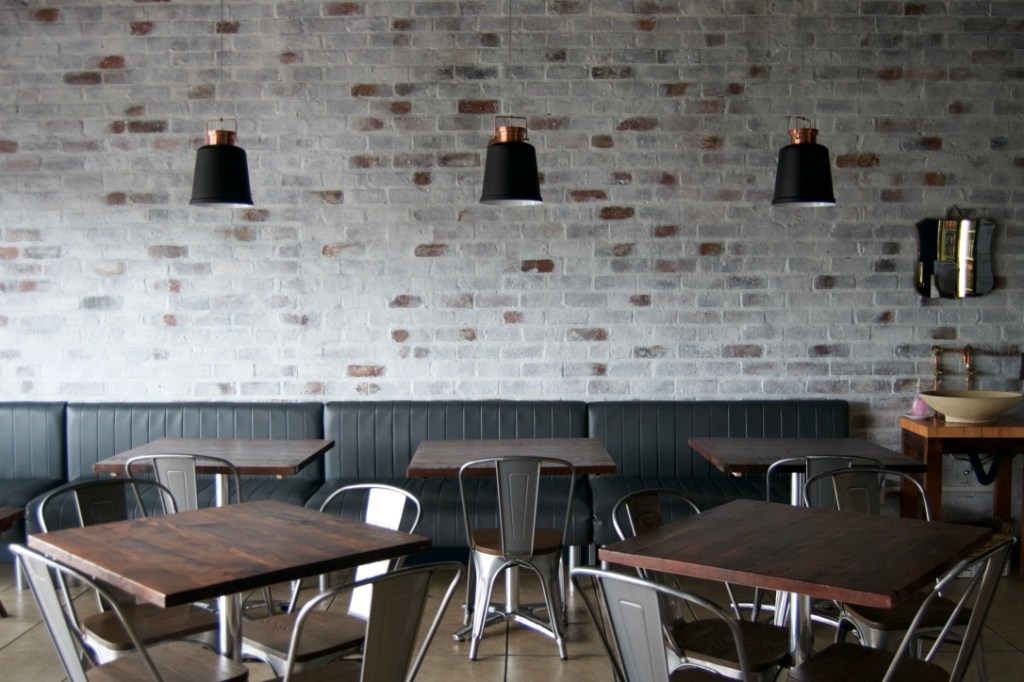
Interior at The Butcher’s Wife
Not only is the food an anomaly in the area but the sit-down format as well. The eateryis the first sit-down, stand-alone restaurant in the area. The restaurant also offers a take-away option. Other sit-down restaurants have opened at the Vangate Mall but these are mainly chain establishments which are well-known throughout the province, even across the nation.
For patrons who are
used to dining and dashing the inviting, comfortable yet sophisticated interior
at The Butcher’s Wife is another
surprise. The interior has a retro feel featuring natural fabrics, like denim
and wood in a simple design. Accessories include brass pipes, unused taps and
antique mirrors to add to the nostalgic feel. And bringing the eatery bang up
to date, the owner has included brass and copper light fittings which are
frequently seen in trendy restaurants in the CBD.
I attended a high school in Rondebosch and I would hear my classmates talk about how they would pop down the road for a coffee date on the weekend. It was during these years that I realised that most areas in the Southern Suburbs and the City Bowl are home to several coffee shops, sometimes even multiple ones on the same street! This prompted me to question why I could not find a cute coffee spot in Athlone in and amongst the gatsby and tikka chicken joints. At the same time we were learning about apartheid during history class and the Group Areas Act caught my attention as a contributing factor to the lack of charming cafès in Athlone.
Apartheid spatial planning
This infamous Act enacted in the 1950s saw the displacement of people of colour from central parts of town to the Cape Flats and townships in far out areas. This displacement forced people to build a new camaraderie in their newly found communities. The bonds built at this time would prove to be the foundations for a well-connected neighbourhood where everyone felt like family.
Families who used
to stay in the leafy suburbs and more central areas were forced out and with
them went their businesses. Tasneem Wentzel in her paper, titled Producing and Consuming the Wembley Whopper
and the Super Fisheries Gatsby: Bread Winners and Losers in Athlone, Cape Town,
says the culinary heritage,
especially the dominance of bread-based food offerings of the Cape is
intricately linked to apartheid laws and regulations.
During the reign of the National Party from 1948 to 1980, white bread was subsidised and regulated by the government. The 1950s to the 1960s are frequently referred to as the “‘wittebroodsdae”[1] where the booming wheat-bread industry reflected a growing self-sufficient white South Africa. White bread forms the basis of gatsbies and several other food items on offer at eateries traditionally known as Halaal takeaways. As a result of the forced relocation, the travel journey from work to home became much longer and cumbersome which meant that people needed a quick and affordable fix for meals.
Homegrown quintessential Halaal takeaways
The need for food
on the go was swiftly met by a string of Halaal takeaways which opened their
doors in the 1970s. Wentzel points out that their critical timing indicates
that the creation of these establishments was, in some way, a reaction to the
intensified political climate and shifting labour market. Serving the people in
the area was the prime objective.
In Athlone, among
the first establishments on the block were Super
Fisheries with their signature gatsby and Wembley Roadhouse with the archetypal whopper burger. These
establishments, despite their food offerings, are generally not referred to as
fast food for several reasons. For starters, categorising them as fast food joints
would be false advertising because believe me, the wait will never be under
twenty minutes, even for a small chip roll. Beyond the tedious wait (which is
always worth it) these businesses generally operate on a smaller scale when
compared to mainstream fast food establishments. Halaal takeaways are almost
always family-based businesses, featuring secret recipes passed down through
generations. Wentzel says these takeaways were and still are able to combine
the foundations of fast food with the flavours of home-cooked food. Therein
lies its authenticity.
The food offerings
are unique and bridge the gap between normal fast food and sit-down restaurant.
I say this because fast food burgers are usually comprised of a generic meat
patty, creamy mayonnaise and some sort of vegetable or pickle, for an illusion
of healthiness, all sat atop a soft but clearly mass-produced roll. Delicious,
nonetheless. However, a burger from a Halaal takeaway features a chunk of
steak, topped with braised onions, garden salad for good measure and a squeeze
of tangy homemade sauce all sitting on a sesame-seed roll. Big difference. The
menu at a Halaal takeaway is broader than that of a fast food joint as it
includes curries, pastas, pizzas and even breyani. Now I must admit that I may
be a bit biased towards these takeaways but it’s so good that I cannot apologise
for it!
The makings of the first sit-down restaurant in Athlone
Now that you have a
sensory visual and are probably salivating at the food scene in Athlone, we
will take a deeper look at the exception to the norm that is The Butcher’s Wife.
The owner of the
establishment, a Muslim women Qudsiya Gangraker is literally a butcher’s wife.
Not only is the restaurant quirky in its very existence but its backstory is
endearing too.
Grangraker is wife
to an owner of PickersMeat, a family-owned brand which was
established in 1994. The Butcher’s Wife exclusively uses Pickers Meat in all of its food offerings, remaining true to the
family-oriented practices in Athlone eateries. In a conversation with
Gangraker, who grew up in Athlone, she said her husband’s link to the meat
trade opened a new door in her food journey. Her parents were grocers so
naturally food trade was in the family. In the interview a dazzling Gangraker
and her brand manager, Michelle Ressel took us down memory lane.
The pair started
their journey in a franchise, St Elmos. The
chain, known for pizzas and pastas closed its doors towards the end of 2016. In bringing the pizza chain to Athlone, the
pair worked on created food offerings which suited the community it would
serve. It was amongst the first in the chain to create a fully Halaal menu, in
other parts of the country there was never an apparent demand for a Halaal
menu. And to satisfy the chilli-loving palates, the seasonings and aromatics
were adjusted. When the pizza chain closed down, Gangraker boldly decided to
combine her knowledge of the Italian-inspired pizza, pasta food offerings and
her husband’s meat trading expertise to bring into being The Butcher’s Wife.
A family establishment: by the people, for the people
In devising the
concept for the trailblazing establishment, Gangraker and her team had the
people of Athlone as their main focus. As a mother of three, Gangraker noticed
the apparent need for a Halaal, family-friendly, sit-down restaurant in the
area. Families enjoy eating out a great deal and she knew that they could do
with an eatery that offered more than standard offerings at the traditional
takeaways. At The Butcher’s Wife, the
motto is, “we sell what we eat”. Wood-fired pizza, gourmet grills, pasta,
artisanal burgers and a scrumptious array of breakfast options. Now these menu
items may not sound like food one would make at home but the flavours taste of
home.
Whilst conversing
with Gangraker at her restaurant, a family popped in for lunch. The children
immediately rushed to Gangraker’s side for a big hug as the parents waved them
over to their table. This interaction is a testament to the types of community
in Athlone and the welcoming nature of The
Butcher’s Wife. The restaurant’s brand manager, Michelle Ressel, said the
advertising for the launch of the establishment was almost exclusively through
word of mouth. Later the eatery created a profile on Instagram, which now boasts almost 7000 followers,but in the very beginning it was locals
recommending the place that got feet in the door. Gangraker said she always
knew how important the community is as the business should fulfill the needs of
the population in the area. She says although the eatery was out of the
ordinary for Athlone, it was met with praise and delight from the day it
opened.
It is clear that
the cosmopolitan nature of the café has been a breath of fresh air in the
community, last month a coffee loyalty card was launched. So far, we have
spoken little about the beverages which in this day and age, where many people
cannot start their without a proper cup of coffee, are equally as important as
the food offerings. At the usual Halaal takeaways the beverage list is usually
limited to soft drinks with the exception of the exemplary Falooda made with
rose syrup which remains a firm favourite. The
Butcher’s Wife truly sets itself apart with its hot drink options, which
include various coffee beverages – one would struggle to find these elsewhere
in Athlone.
As one can see The Butcher’s Wife mimics the
community-centered culture cultivated by the Halaal takeaways which form a
defining role in our culinary heritage.
Succeeding on the periphery
The Group Areas Act
pushed people of colour into the outskirts of the city, away from the City Bowl
and with that came the othering of these displaced communities. People do not
expect to find artisanal coffee shops, gourmet food offerings and sophisticated
eateries on the Cape Flats. They expect
the usual, dine-and-dash Halaal takeaways and nothing more.
“People come and
say, we would never have known that you can have something like this in
Athlone. Then I thought, why not, don’t we deserve to have something like
this?”
These were Gangraker’s words, she says restaurants in the suburbs are not celebrated enough. Most foodies gush over the delectable food on offer in the CBD, the Atlantic Seaboard and Constantia but they neglect those on the periphery. Food outlets in the Cape Flats exist outside of the mainstream and are therefore seen to exist on the periphery. It is an extended manifestation of apartheid-era spatial planning which continues to exist, especially in Cape Town. A self-appointed dyt[2] specialist, Huda says halaal takeaways do not exist on the periphery to the people on the Cape Flats rather, these illustrious eateries are at the centre. Despite the fact that the majority of Capetonians indulge in these takeaways fairly frequently, the city’s minority, who wield the economic and social power, continue to diminish their successes.
Gangraker says she
cannot charge her diners the same prices one would pay at a mainstream
restaurant in the city. The families here, are for the most part, not aware of
the high prices restaurant charge and therefore would not be prepared to pay
those hefty prices at The Butcher’s Wife.
For this reason, she keeps her prices relatively low, without compromising on
the quality and consistency of the food. However, Gangraker says that Halaal
consumers are willing to spend a reasonable portion of their disposable income
and this spending capacity is frequently underestimated. Media and people in
general tend to believe that the big eaters and therefore money lies in
affluent suburbs and the CBD.
The Butcher’s Wife breaks the stereotype and even the toughest of critics approve
The grannies in the
family are notorious for their fussy eating habits, they will not smile and
move on if their taste buds are dissatisfied. Bold as ever, they will voice
their opinions. Gangraker says even these ladies, the toughest of critics gleefully
enjoy a feast at The Butcher’s Wife. Even
though many of them grew up eating foods from Halaal takeaways they have
clearly welcomed The Butcher’s Wife
into their dining out regime.
[1] Reference to the honeymoon phase for the white population in Apartheid South Africa
[2] Slang word used on the Cape Flats to denote eating
Prisons do everything but rehabilitate, here’s why we should care:
In a landmark case, transgender inmate, Jade September won her case against the Department of Justice and Correctional Services last month. The High Court in Cape Town, sitting as the Equality Court, ruled that she be allowed to express her gender behind bars. This ruling comes after September suffered months of discrimination. September’s case puts a spotlight on prison reform and the desperate need for transformation in the Correctional Services.
South African prisons have a haunting history. The prison system was militarised in the 1950s under the Apartheid regime. One of the main objectives of prisons under the regime was to keep inmates out of the community. The treatment of prisoners, specifically people of colour was inhumane and designed to do the opposite of rehabilitate.
However through the democratization process, the Department of Correctional Services officially committed to a policy that aims to make prisons more humane places. The policy-makers were of the view that rehabilitating offenders was crucial for their successful integration back into society. It seems this commitment has been forgotten as the years have gone on.
Prisons are overcrowded, ruled by gangs and treatment is anything but humane. For this reason and several others research has shown that close to 90% of prisoners in South Africa reoffend after their release. This is a clear indication that the prison system is not rehabilitating inmates, but rather creating hardened criminals. This is however not an issue unique to South Africa. In the United States almost half of the inmates are arrested again within eight years of their release from prison.
The lack of rehabilitation mainly stems from a lack of resources many prisons have severe space constraints and do not have rooms in which to run programmes that facilitate the process. Prison conditions are not conducive to a learning environment. The fact that this is not an issue unique to South Africa or even the third world shows that perhaps the problem is not necessarily the insufficient resources but rather a lack of care for the plight of prisoners. Most tax-payers do not want to hear that their money is going to pay for services for criminals. Logically one should however see that rehabilitating convicts is in the best interest of everyone because it is the thing that will lead to a decrease in repeat offenders thus decreasing crime.
The 2019/2020 departmental budget shows administration and incarceration receive far more resources than rehabilitation. According to the Business Day of the R25.4 billion allocated for the financial year, 78% goes towards those two items incarceration and administration. Rehabilitation and social reintegration receive just 12% of the budget.
The one place where some, very little, transformation can be seen is in healthcare, this came after Dudley Lee, a former inmate at Pollsmoor, won his case against the department in the Constitutional Court in 2016. The case indicated a need for the overhaul of health services and prevention in prisons. Internationals funding was received to facilitate this but little change can be seen. At any point Pollsmoor can be seen to be 38% overcrowded, which makes way for the spread of infectious diseases.
Even with additional funds in order to create a proper strategy to target the issues plaguing the prisons accurate data is needed, this however is another issue. In the 2016 budget vote speech, Correctional Services Minister Michael Masutha said the auditor-general had serious concerns about the credibility of records for its incarceration, rehabilitation and care programmes. He added that the data was not reliable when compared to the evidence provided. This calls into question several crucial indicators.
Prison reform and human rights advocates need to place pressure on the government to take responsibility and remain true to their promises listed in legislation. This involves making an effort to reduce overcrowding by rehabilitating and preventing the occurrence of repeat offenders. Improving prison infrastructure and access to basic health services to allow for an environment conducive to learning and healing.
The justice system also needs reforming in terms of bail policies and practices, reviewing prolonged detention of individuals awaiting trial and sentence as several instances of overcrowding can be attributed to those awaiting trial.
It is time for civil society to rally behind cases like those of Jade September and realized that the plight of criminals should be a concern. Civil society groupings need to actively look to innovative ways to assist prisoners in their rehabilitation as could be seen with the support September received from GenderDynamix. Fyodor Dostoyevsky once said, “a society should be judged not by how it treats its outstanding citizens but by how it treats its criminals.”
Multinationals have shirked their responsibility in global warming for too long
At least 100 companies are responsible for 71% of global emissions since 1988, according to the findings of a 2017 Carbon Disclosure Project (CDP) report. Corporations with major financial power in the global landscape are not being held accountable for their contribution to global warming and climate change.
Earlier this month, 16-year-old Greta Thunberg led a group of young climate activists from across the world, in an address at the United Nations Climate Action Summit. She address was biting and honest, an attempt to make world leaders make the necessary changes in their state legislation in order to fight against climate change:
“You have stolen my dreams and my childhood with your empty words. And yet I’m one of the lucky ones. People are suffering. People are dying. Entire ecosystems are collapsing. We are in the beginning of a mass extinction. And all you can talk about is money and fairytales of eternal economic growth. How dare you!”
One of the most notable actions by states to fight global warming is the formation of the Paris Agreement, created within the UN Framework Convention on Climate Change. The signatories on the agreement commit to keeping a global temperature rise this century well below two degrees Celsius above pre-industrial levels. They resolve to work towards limiting the temperature increase even further to one and a half degrees Celsius.
Despite the fact that this Agreement was signed by almost 200 countries worldwide, carbon emissions are rising. In order to limit warming to just 2 degrees Celsius, as the Agreement reads, the effectiveness of global climate policies need to triple in scale. This is according to a UN report released this year. These findings suggest that state leaders alone cannot fight this fight.
We need commitment from large multinational corporations themselves.
Multinationals like Gazprom and ExxonMobil wield phenomenal power. They oversee huge supply chains, sell products all over the world, and help mould international politics to their interests. And as they generate profits through their daily transactions, they are also releasing carbon emissions. Last year ExxonMobil, the largest investor-owned oil company globally, said that it would spend $1 million over two years to lobby for a carbon tax in the United States.
At face-value this commitment seems to show that the corporation is attempting to join the fight against climate change, however, the pledge comes with a catch. In exchange for lobbying for the tax, the company wants immunity from all climate lawsuits in the future. This is just one example where a multinational uses its financial power to shirk responsibility. According to TheEconomist the oil giant plans to pump 25% more oil and gas in 2025 than in 2017.
The proposal for the carbon tax brought by ExxonMobil also shows the interplay which exists between interplay between state and corporate power. This interplay plays a defining role in international relations and for this reason the actions taken by big corporations with deep pockets cannot be overlooked.
Thunberg mentioned the world leaders’ fascination with economic growth in her address indicating that this factor is at the forefront in most policy and decision making discussions. For this very reason corporation executives need to be a focal point in the conversations on climate change – they need to be called out directly. Multinationals should equally not be celebrated for vowing to diminish emissions or carrying out any climate-related campaign because it is their ethical and moral responsibility.
However, as long as there is a demand these corporations will remain in business and be protected. As much as government legislation and commitments inspire some hope in the strengthening of the fight against global warming, it is up to the private sphere to take the leading role.
We as consumers need to put pressure on powerful companies to effect change. Spend your resources consciously – don’t buy products unnecessarily and speak to your network about how they are contributing to climate change. The likes of Thunberg need to speak directly to company executives and they need to take responsibility for the reality they have created.
Violence against women, gender non-confirming and gender non-binary persons is a reality that we have been forced to live with for too many decades. According to Stats SA femicide in South Africa is 5 times higher than the global average. Femicide, is a horror not unique to the South African society. So far this year, just over 100 women were killed in France.
Two societies and two leaders with contrasting strategies to root out the scourge. President Cyril Ramaphosa should take a few notes from the French Prime Minister, Edouard Philippe on how to approach the crisis.
France and South Africa have different economical and social factors which contribute to the strategy to eradicate gender-based violence (GBV). However, the impact of the leader of the nation cannot be underestimated. Ramaphosa has floundered where Philippe has managed to keep his head above water.
The rape and brutal killing of Uyinene Mrwetyana has shaken our society, sparking several actions against GBV from civil society. In 2013, the rape and killing of Anene Booysen rattled the country and in 2017, the murder of Karabo Mokoena was dubbed a wake-up call. Back-tracking even further, in 2005, Fezekile “Khwezi” Kuzwayo accused Former President Jacob Zuma of rape and he was later acquitted. Countless other women have been killed and raped at the hands of men, many remain nameless. If we have experienced at least three tragedies that resulted in mass outcry why is the lived reality not getting any better for women?
Due to Zuma’s nefarious dealings, his Presidency term is frequently referred to as the “lost years”. In his election campaign Ramaphosa promised a new dawn, fuelled by ethical leadership and plans to root out the rot. Well, the new dawn has left much to be desired for the safety of women.
A summit addressing femicide and GBV was hosted at the end of November 2018. The results of this summit included; a draft National Strategic Plan, plans to consult various community stakeholders and a rapid response team to address emerging issues. Too many plans, not enough action.
In France, Philippe arranged for a summit to address femicide within a week from when the 102nd women was killed. The outcomes of this summit included; the creation of 1000 shelters and emergency accommodation as well as an audit of 400 police stations to see how women’s complaints are handled. He said further that €5m would be released in the fight against femicide. Philippe went so far as to suggest that those convicted of domestic violence or under a restraining order would have to wear an electronic bracelet to protect women from further violence. Active steps, something our society is begging for.
When a country is in crisis and civil society feels disillusioned the government needs to step up to the plate. The government’s initial response to Mrwetyana’s murder sparked outrage on social media. In a tweet it called on, “women to speak out, and not allow themselves to become victims by keeping quiet.” This tweet was later deleted and shortly after a string of tweets were posted where government called on, “on men to lead the change we want to see in our society.” Though the second attempt places some responsibility on men, it is not harsh enough as it is widely understood that the majority of the perpetrators in crimes against women, are men.
This month, thousands, young and old, marched to Parliament, protesting against GBV. The tenacity and anger in the crowd was met by a list of limp promises from the President in his address outside Parliament. The trust between the state and citizenry is broken and therefore promises inspire little to no hope. The question is then, what should the President have done? For starters, he should not have waited until thousands took to the streets to address the public. The wait communicated an apparent lack of care for the plight of women.
In France, there were no marches and there were no disruptions instead outrage over femicide was communicated through posters and silent demonstrations. And yet, the Prime Minister was able to muster up more than mere promises. Philippe, at a news conference, has some necessary harsh words for men on their complicity in GBV; “very often it is a process of sexist control, so ingrained in our mentalities and our habits that some men have grown used to a form of impunity.” This response was not necessitated by public disturbance and protest but (hopefully) the concern of a Prime Minister for his people.
Genuine care and concern is the main difference between these two world leaders and their strategy for tackling femicide. We are all aware of the painful reality that the fight against GBV requires more than one solution. This is precisely why the words and actions taken by the leader during this time are so important.
This is an example post, originally published as part of Blogging University. Enroll in one of our ten programs, and start your blog right.
You’re going to publish a post today. Don’t worry about how your blog looks. Don’t worry if you haven’t given it a name yet, or you’re feeling overwhelmed. Just click the “New Post” button, and tell us why you’re here.
Why do this?
Because it gives new readers context. What are you about? Why should they read your blog?
Because it will help you focus you own ideas about your blog and what you’d like to do with it.
The post can be short or long, a personal intro to your life or a bloggy mission statement, a manifesto for the future or a simple outline of your the types of things you hope to publish.
To help you get started, here are a few questions:
Why are you blogging publicly, rather than keeping a personal journal?
What topics do you think you’ll write about?
Who would you love to connect with via your blog?
If you blog successfully throughout the next year, what would you hope to have accomplished?
You’re not locked into any of this; one of the wonderful things about blogs is how they constantly evolve as we learn, grow, and interact with one another — but it’s good to know where and why you started, and articulating your goals may just give you a few other post ideas.
Can’t think how to get started? Just write the first thing that pops into your head. Anne Lamott, author of a book on writing we love, says that you need to give yourself permission to write a “crappy first draft”. Anne makes a great point — just start writing, and worry about editing it later.
When you’re ready to publish, give your post three to five tags that describe your blog’s focus — writing, photography, fiction, parenting, food, cars, movies, sports, whatever. These tags will help others who care about your topics find you in the Reader. Make sure one of the tags is “zerotohero,” so other new bloggers can find you, too.


 Umami politics